APPIso Trainer for Android
The protocols, the records and the report. Not just the readout.
A bare force tester gives you a peak. Iso Trainer gives you the test that produced it, the client it belongs to, the target it sets for next week and the PDF that proves the change. Built for the coach's phone and the gym's TV.
Live training screen · Instrument design system
01Live training
Readable from three metres. Honest at 250 Hz.
The number is the interface. Everything else recedes so the athlete gets one glance and the coach gets the metrics.
Zone contract
Green, amber, red, gold
In zone, below, above, record. The colours never change meaning anywhere in the app.
Ghost curve
Beat the last attempt
The previous best force curve draws behind the live one, with a live delta readout. The most motivating visual in force training, at no extra cost.
Cues
Audio, haptic, voice
Countdown, GO, zone change and attempt end as tones or spoken cues. Eyes stay on the athlete, not the screen.
Record moment
Freeze, flash, share
A new PR freezes the screen and produces a shareable card. Members post it; the facility gets the credit.
Standardised instruction
Same words every session
"Ramp up and pull as hard as possible." A fixed cue per mode keeps this month's number comparable with last month's.
Quiet baseline
No pretension, no bad RFD
Movement before GO is detected. Explosive metrics are withheld rather than reported wrong.
02Protocols
Fourteen built in. Unlimited custom. Every one editable.
Templates carry evidence-aligned defaults. Coaches change sets, rest, tolerance and targets; every activity stores a snapshot of its protocol so history never changes when a template does.
Isometric Max Test
3 × 5 s maximal · 120 s rest · optional 50/75/90 % warm-up
80 % Hold
5 × 5 s at 80 % of max · ±5 % zone · 30 s rest
70 % Hold
5 × 5 s at 70 % of max · ±5 % zone · 30 s rest
Break Your Record
One maximal effort against the personal-record line
Repeated Max Efforts
5 × 5 s maximal · 20 s rest · drop-off computed
Force Endurance
Stay above 60 % as long as possible
Force Ladder
60 › 70 › 80 › 90 % › MAX
Progressive Contraction
40 › 55 › 70 › 85 › 100 % over 10 s · tracking-error scored
Explosive Isometric
3 × 3 s · 45 s rest · RFD at 100 / 200 / 300 ms
Tendon Loading Protocol
5 × 45 s at 70 % · 2 min rest · in-season tendon loading
Isometric BP Protocol
4 × 2 min at 30 % · 3 sessions per week · adherence tracked
Return-to-Sport Battery
3 maximal per side · fixed joint angle · LSI vs ≥ 90 %
Adductor Squeeze Monitor
2 maximal squeezes weekly · N/kg trend
Neck Strength Block
40 › 50 › 60 % · conservative progression
Nine training modes underneath: max test, target hold, beat record, repeated max, endurance, ladder, progressive curve, explosive and custom step lists. A readiness check (two submax pulls against the client's rolling baseline) can open any session and suggest scaling the day's targets.
03Clinical and performance programs
Built for the physiotherapist who has to write the report.
Return to sport
LSI per metric, not per impression
Guided both-sides battery: max then explosive, left then right. The report shows Limb Symmetry Index for peak force, RFD 0–200 ms and impulse with green, amber and red bands, side by side with the previous battery. Exported as PDF.
Tendon care
Load against pain, week by week
Scheduled loading sessions at a coach-selectable frequency, a pain diary with morning-stiffness score, and a load-versus-pain chart. The outer loop tendinopathy management needs and a bare sensor cannot provide.
Blood pressure
An eight-week isometric course
Four two-minute holds at 30 %, three times a week, with adherence tracking and a weekly resting-BP log. Supports healthy blood pressure; complements, never replaces, medical care.
Safety gates
Governance a clinic can sign off
Clearance acknowledgement, a cardiovascular flag with an intensity cap, per-client ceilings, injury notes on the live screen and a "keep breathing" cue on long holds.
Autoregulation
Today's targets from today's readiness
Two submax pulls at session start compared with the rolling baseline. A force-loss stop rule ends repeated efforts when output drops below a threshold the coach sets.
Joint angle
Camera-measured setup
Pose estimation from the phone camera records knee or elbow angle at setup, so a fixed-angle test is measured rather than eyeballed.
04The floor
One sensor becomes an event.
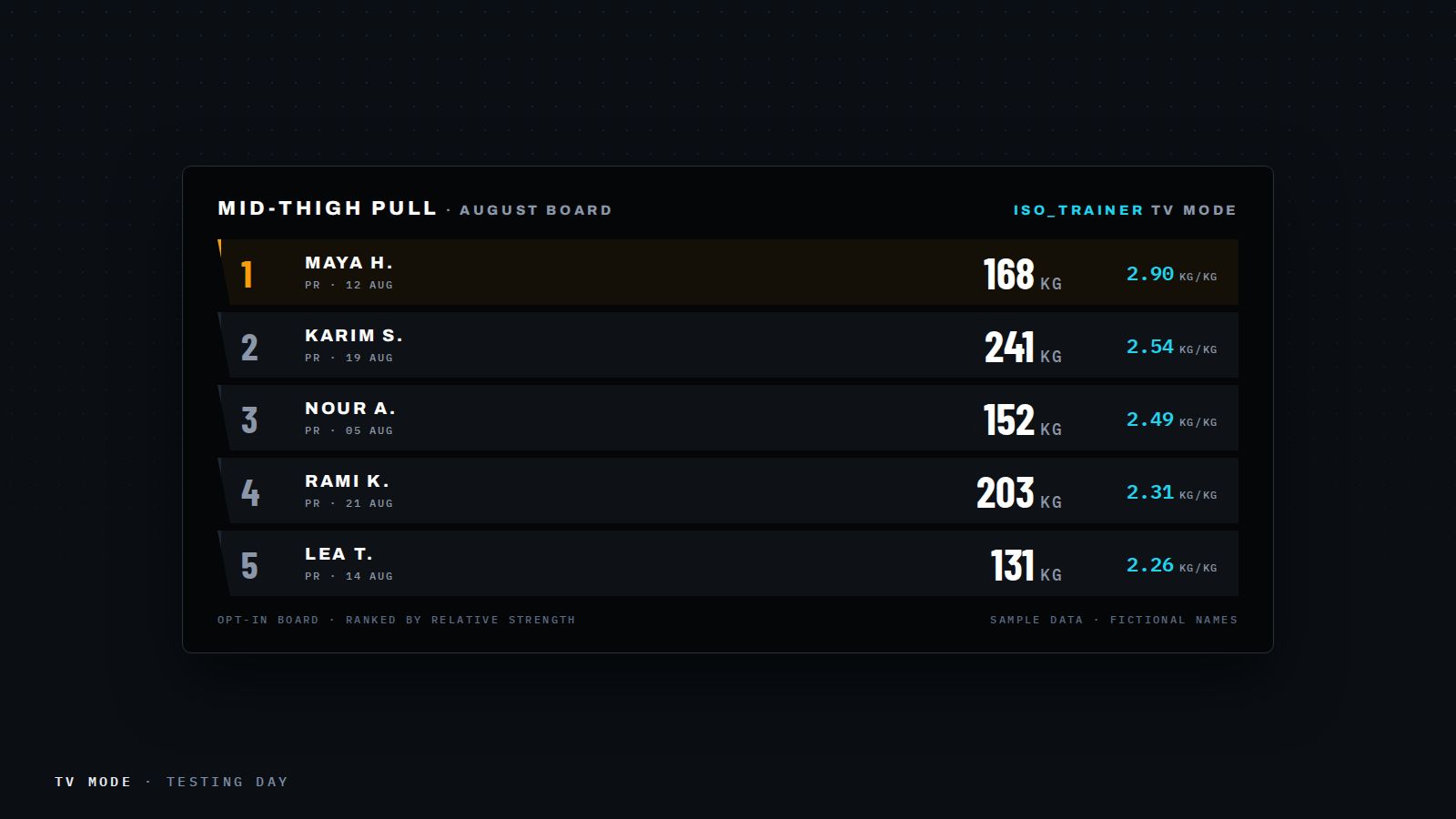
TV mode scales the live screen for a gym display. Wall mode runs a testing day station by station. Leaderboards, challenges and percentiles turn a Tuesday test into something members come back for.
- TV mode. Broadcast-scale numerals, readable from the squat rack.
- Testing-day wall mode. Roster in, station by station, results on the wall.
- Leaderboards and challenges. Opt-in boards per organisation, including relative-strength boards so lighter members compete fairly.
- Percentiles from your own data. "Stronger than 78 % of members" — computed from your facility's tests, not a published table.
05Records and reports
The business layer is included.
Clients
Profiles and history
Status, packages, payment state, injury notes, clearance, per-exercise max history and personal records.
Progress
Trend per exercise
Peak, RFD and session load charted over time. Isometric session load is computed from impulse and trended weekly.
Export
PDF and CSV
Progress report and return-to-sport report as PDF. Every attempt exportable as CSV for your own analysis.
Cloud
Offline-first sync
Email sign-in, roles per user, cloud backup of every session and force curve. Works without signal; syncs when it returns.